
The Sims 4 Horse Ranch
The Sims 4 Horse Ranch Expansion Pack Horse Ranch quickly became one of the most anticipated expansions in The Sims […]

Andor
2026/08/19

Growing Together is one of the most ambitious family‑focused expansions in The Sims 4, reshaping how players raise a Sim family from infancy through adulthood. Released alongside the free “Infants” update, it transformed the life cycle experience by integrating milestones, family dynamics, and generational gameplay into a cohesive system. The pack serves as a spiritual successor to earlier family‑oriented content such as Family Fun Stuff, Generations, and Parenthood, bringing together the most comprehensive family‑life features in the series to date.
| The Sims 4: Growing Together | |
|---|---|
| Developer: | Maxis, The Sims Studio |
| Publisher: | Electronic Arts (EA) |
| Platform at launch: | Windows, macOS, PS4/5, Xbox One/Series |
| Release date: | March 16, 2023 |
| Worlds | San Sequoia |
| DLC release order | 62 |
| Expansion Pack release order | 13 |
Growing Together’s central theme is family — how Sims are raised, how they bond (or clash) with relatives, and how the choices players make ripple across generations. Rather than adding one flashy new career or life state, the pack layers several interconnected systems on top of existing gameplay, making family life in The Sims 4 feel far more reactive and personal than before.

The pack’s new world, San Sequoia, is a bustling town with historic roots inspired by the San Francisco Bay Area. It blends quiet suburban streets with a lively community center, giving families plenty of reasons to leave the house. Notable spots include an urban park, a public library stocked with children’s books, a movie theater, and a water park, along with the influential local Robles family who help set the tone for the neighborhood’s own long-running drama. While some reviewers felt San Sequoia’s individual lots lack the personality of earlier Sims 4 worlds, it remains a functional, activity-packed backdrop tailor-made for multi-generational households.
| Lot Name | Type | Lot Size | Description |
|---|---|---|---|
| 7 Eucalyptus Lane | Residential | 50×40 | Home of the Michaelson family, a spacious suburban house. |
| Robles Point | Residential | 50×40 | Residence of the Robles family, tied to the town’s fishing history. |
| 13 Acacia Avenue | Residential | 40×30 | Robles-Ruano family home, a creative and expressive household. |
| 36 Bayani Place | Residential | 30×20 | Luna-Sullivan family residence, a quirky multigenerational household. |
| Sequoia Cottage | Residential (Uninhabited) | 30×20 | Vacant cottage-style lot, available for building. |
| Parkside Place | Residential (Uninhabited) | 30×20 | Vacant suburban lot, ideal for family homes. |
| 23 Eucalyptus Lane | Residential (Empty) | 30×20 | Empty lot available for custom builds. |
| Manzanita Terrace | Residential (Empty) | 30×20 | Empty lot in Hopewell Hills, ready for construction. |
| 18 Celebration Way | Residential (Empty) | 40×20 | Larger empty lot near Gilbert Gardens. |
| Anchorpoint Abode | Vacation Rental | 30×20 | Rental lot in Anchorpoint Wharf, styled for visitors. |
| Anchorpoint Library | Community – Library | 30×20 | Public library in Anchorpoint Wharf, ideal for study and reading. |
| Celebration Center | Community – Recreation Center | 64×64 | The largest lot in San Sequoia, a recreation hub with activities for all ages. |
Growing Together shipped alongside a free base-game update that finally freed babies from the bassinet, introducing an entirely new Infant life stage. Infants arrive with their own starting trait — Cautious, Intense, Sensitive, Wiggly, Calm, or Sunny — and grow through 18 unique infant quirks that shape their behavior. Toddlers also received 18 brand-new quirks of their own. Parents need to change diapers, teach basic life skills, and help infants hit gross- and fine-motor milestones, while new items like carriers, bassinets, high chairs, and four new crib types make day-to-day caregiving easier. Players who’d rather skip WooHoo altogether can also use the new “Science Baby” feature to have a child.
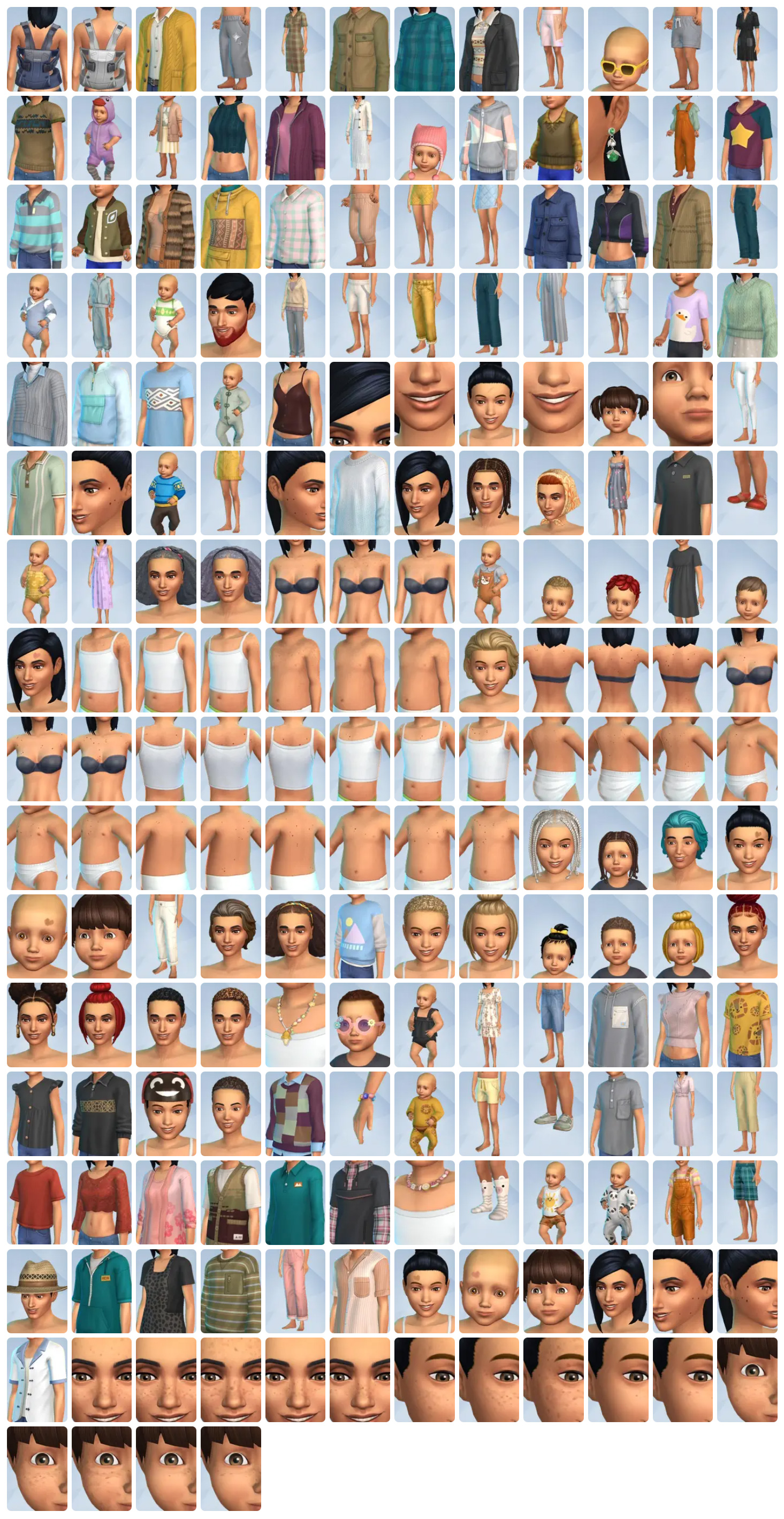
Create-A-Sim customization goes deep for the new life stage too, with new skin tones, hairstyles, accessories, and outfits for infants and toddlers, plus stork-bite scars that fade naturally as a Sim grows older.
Family Dynamics is one of Growing Together’s headline systems, determining how related Sims actually get along. Every household can be assigned a dynamic — ranging from Supportive to Difficult — shaped by Likes and Dislikes across new Sim Characteristics and Conversation Topics categories set in Create-A-Sim. Some relatives naturally become close companions, while others get pushed to the outside of the family circle, adding an unpredictable layer of drama or harmony to every household.
Closely tied to this is Social Compatibility: Sims will now click instantly with some strangers and immediately clash with others, based on new social preferences that determine who becomes a lasting friend and who becomes a lifelong rival.
Milestones give players a running record of a Sim’s biggest life moments, from finding love to hitting career setbacks to making a new friend. Achievements are organized into Firsts, Life, and Social categories, and some even award object rewards like certificates and keepsakes. Sims genuinely remember these events too — a Milestone tied to a specific location can resurface in a Sim’s memories or mood the next time they visit that spot, giving San Sequoia’s locations a sense of lived-in history.
Growing Together adds several new life events that push Sims to evolve rather than stay static. Teens and adults can go through Self-Discovery, where the game may offer to swap out an existing trait for its opposite (a Slob becoming Neat, for example) — players can accept the change or reject it, and a Sim can gain up to three new traits this way over a lifetime. Adult Sims can also face a Midlife Crisis, dealing with Workplace Rivals, Burnout, and even Random Layoffs along the way. On the lighter side, kids can now learn to ride a bike, lose their baby teeth, build Friendship Bracelets, and host sleepovers complete with Temporary Stay Overs and slumber-party sleeping bags.
Growing Together’s build and buy catalog leans heavily into family and childhood themes, adding everything from nursery furniture to backyard play equipment. A standout addition is the giant customizable treehouse, which is large enough to function as a small standalone house of its own. Other notable additions include:
Growing Together’s catalog focuses on nursery and family-room essentials, playground equipment, and cozy multi-generational furniture — think cribs, playmats, treehouses, and backyard swing sets designed to make a household feel lived-in by Sims of every age.

The pack’s Create-A-Sim additions center on infants, toddlers, and children, adding new skin tones, hairstyles, accessories, and outfits for the youngest Sims, along with stork-bite scars usable across all life stages. It gives players far more room to make every generation of a family look distinct, from a newborn’s first outfit to a grandparent’s signature style.
On Metacritic, The Sims 4: Growing Together holds a “Generally Favorable” critic score of 82/100 based on nine reviews, making it one of the better-received expansion packs in the game’s later lineup — though its user score sits lower, at 6.4/10, reflecting a more mixed reaction from the community. Critics generally praised how much depth the pack adds to family gameplay: reviewers highlighted the combination of Milestones, Family Dynamics, and expanded Create-A-Sim and Build/Buy options as long-overdue additions that make individual Sims feel more like real people with real histories. Some reviewers did note that San Sequoia itself feels a little shallow compared to previous worlds, and that the new Social Dynamics systems — with their built-in potential for jealousy, rivalry, and conflict — won’t appeal to every playstyle, particularly players who prefer a calmer, drama-free household.
For players who love story-driven, family-centered gameplay — raising kids from infancy, watching personalities evolve through Self-Discovery, or building out multi-generational households full of quirks and Milestones — Growing Together is one of the most substantial expansions in The Sims 4’s catalog. Its combination of the free Infant life stage, deep Family Dynamics, and a steady stream of new life events makes it an easy recommendation for anyone who wants their Sims’ family life to feel more connected and reactive. Players mainly interested in a flashy new world or career path may want to look elsewhere, but for family-focused storytelling, Growing Together delivers exactly what its name promises.